


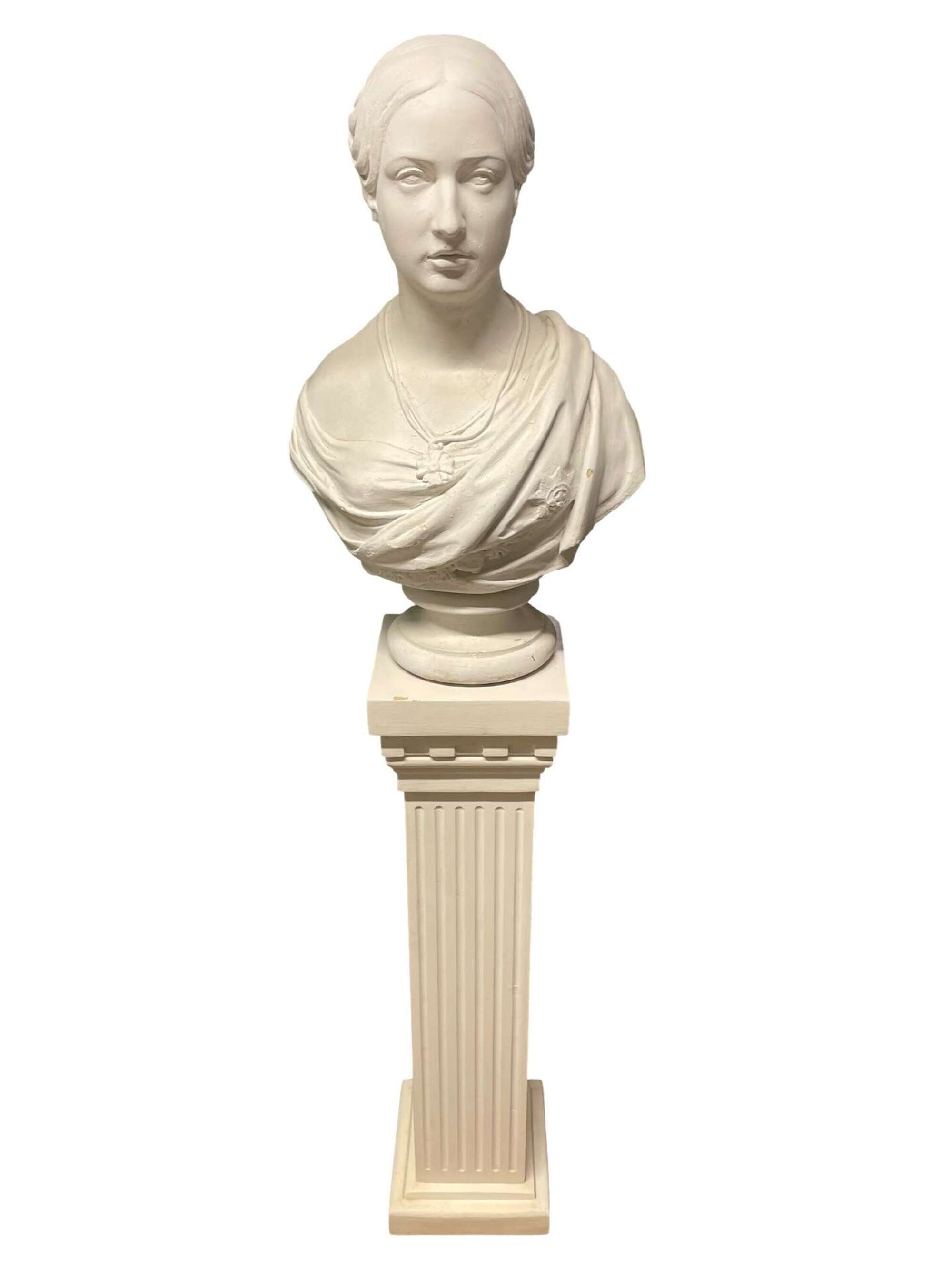
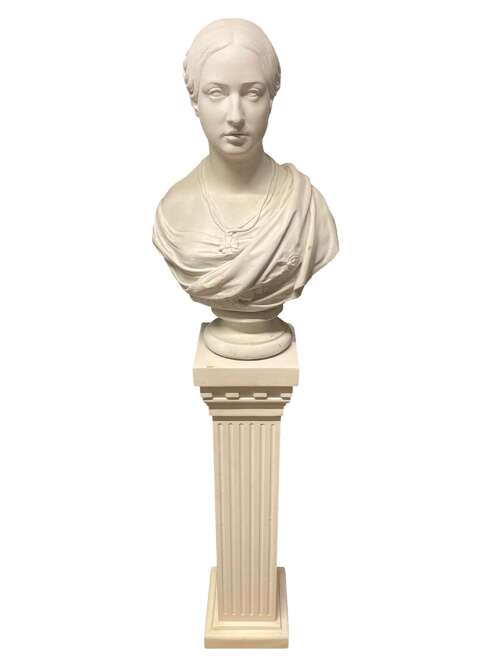



Antique Large Sculpture Bust Of Young Queen Victoria By William Scoular, London
Delivery Quote Request
Please fill in the form below to request a delivery quote from Atlas Antiques.
Contact Atlas Antiques
 Swanage, United Kingdom
Simply fill in the below form to get in touch with Atlas Antiques regarding this item.
About this item
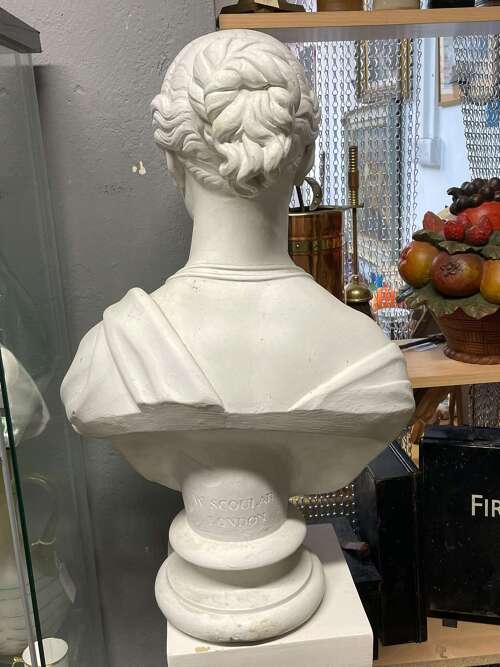
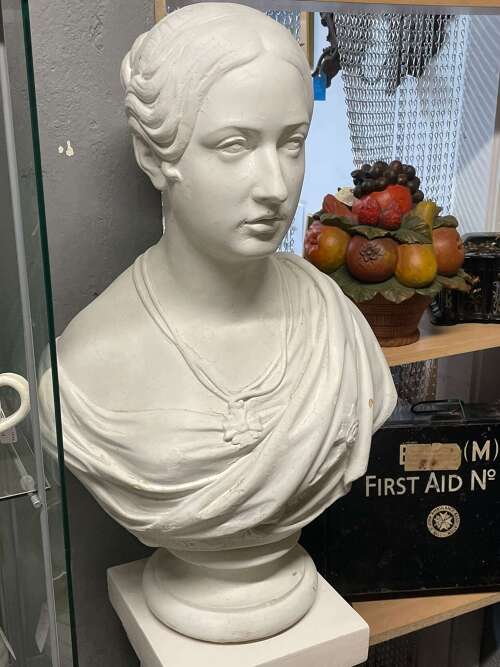
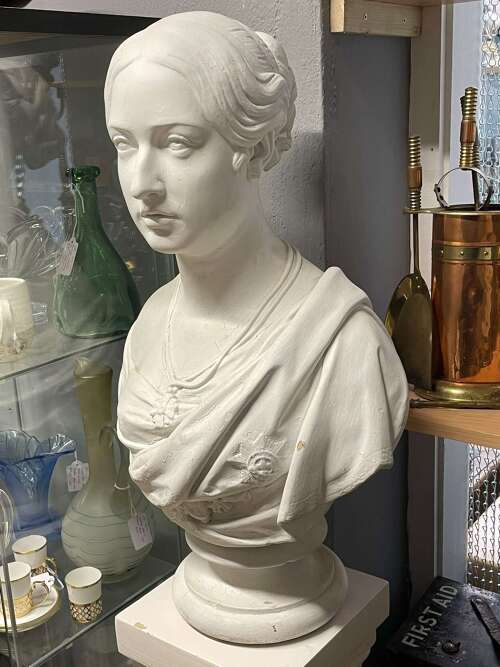
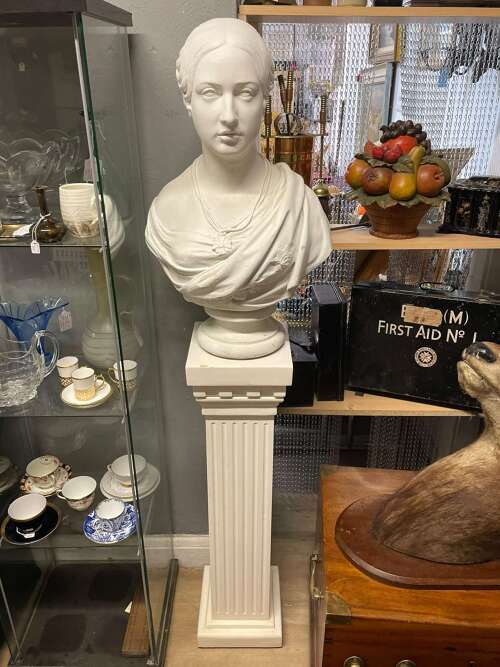
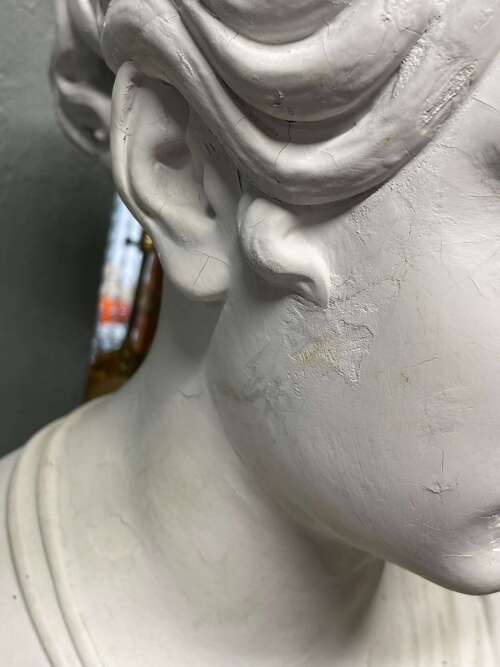
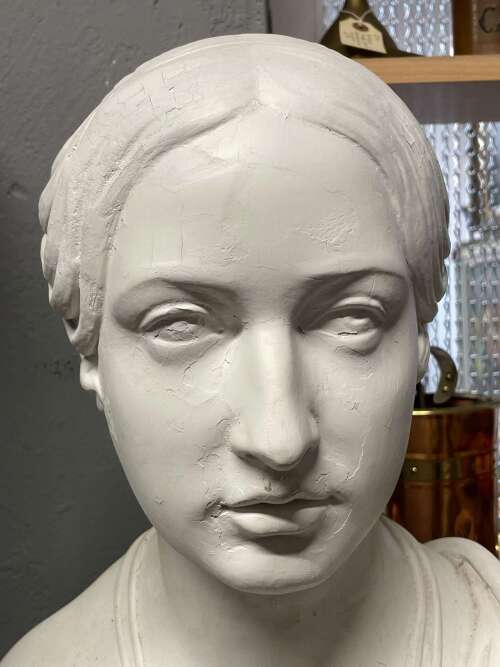
For sale is an Antique Large Sculpture Bust Of Young Queen Victoria By William Scoular, London.
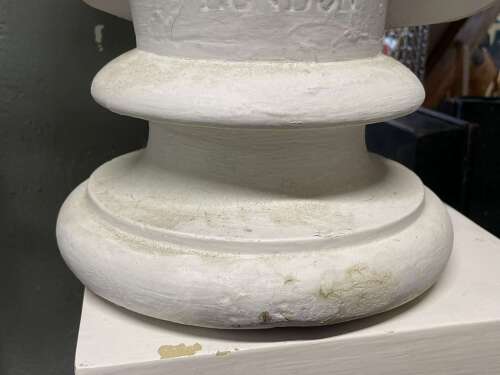
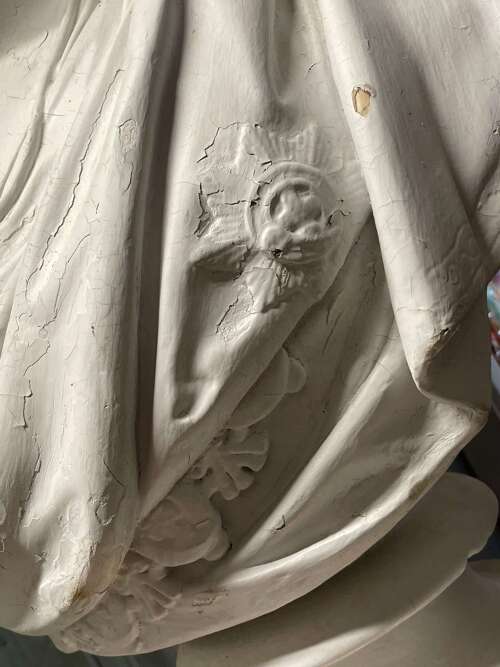
This is in mostly good condition, unfortunately it has been painted over in white paint which can be stripped down. Also small chip to paint layer on garments.
This has been produced in plaster, and it’s signed on the back of the neck “W. Scoular, London.” Which is the famous sculpture William Scoular, London who was born in 1796 and died in 1854.
This sculpture measures 69cm height c 47cm length x 30cm width.
Little is known of William Scoular’s early life but he studied under John Graham at the Trustees School of Design in Edinburgh before moving to London in 1814. There he became a pupil of Sir Richard Westmacott and attended the Royal Academy schools from 2 August 1815. He was living in Clarendon Street, Somer’s Town in 1816, when he received a silver medal from the Society of Arts for a copy of a large antique statue of Faunus and in 1817 gained the RA gold medal for a relief of the Judgement of Paris and a silver medal for a model of Patroclus slain. He applied for the RA travelling scholarship to Italy in 1818 but his request was rejected after Sir Thomas Lawrence argued that he had not shown sufficient ability. John Flaxman was among the Academicians who voted against him, though the portrait painter Thomas Phillips argued that the Academy acted inconsistently in refusing to send Scoular to Rome after awarding him the gold medal. He was living in Edinburgh in 1820 when he was again recognised by the Society of Arts and was awarded the Isis gold medal for a group entitled Brutus and his son.
In 1821 the Duke and Duchess of Clarence (the future King William IV) commissioned Scoular to take the death mask of their infant daughter, Princess Elizabeth. He also carved a small figure of the child asleep on a couch, now at Windsor Castle. He was appointed sculptor in ordinary to the Duke and Duchess in 1823. Two years later Scoular defeated Joseph Gott by four votes to win the RA travelling studentship and went to study in Rome. He remained there for several years and a writer in the Literary Gazette noted that ‘his modest and retired habits estrange him from his countrymen visiting Rome’. After his return to London in 1829-30 he bought the business of Sarti, ‘a well-known Italian modeller. The enterprise did not succeed and he had returned to work as a sculptor by 1836, when he sent four busts to the RA exhibition.
Scoular spent almost all his career in London, working from various addresses in the area around the Middlesex Hospital and in Soho. However, he continued to cultivate Scottish connections and in the early 1820s kept a studio in Mound Place Edinburgh, where Scottish patrons came to sit for him. Several of his works were issued as prizes by the Association for the Encouragement of the Fine Arts in Scotland and the Art Union of Scotland. He exhibited in London, at the RA (1815-1846), the British Institution (1816-1843) and the Society of British Artists (1824-1838) and in Edinburgh at the Royal Scottish Academy (1832-1847) and the Royal Institution for the Encouragement of the Fine Arts in Scotland (1821-1822).
Scoular’s exhibits included a number of ideal works based on classical and biblical subject matter. A figure of Narcissus, shown at the RA in 1825 was warmly received by the Literary Gazette, whose reviewer wrote ‘we have rarely seen a more beautiful model, chaste in design, just in its proportions and graceful in action’ (Lit Gaz, 1825, cited by Gunnis 1968, 346). However, the sculptor’s output was dominated by portraiture and in 1838 the same journal praised a marble statue of Sir Walter Scott, which appeared in that year’s RA exhibition, remarking that Scoular had been ‘fortunate in giving an elevation to the figure of this great writer correspondent with that of his genius’ (Lit Gaz, 1838, 346, cited by Lady Lever 1999, 74). It can probably be identified with a seated figure of the author at the Lady Lever Art Gallery, in a relaxed attitude with his arm resting on a bookcase and his favourite dog at his knee. This work was formerly ascribed to Sir Francis Chantrey but it is closely similar in style and format to Scoular’s statue of the Scottish engineer and scientist James Watt and the two figures may have been conceived as a pair. The sculptor’s bust of Prince Albert was less successful: the Art Union condemned it as ‘among the worst portraits of the Prince we have seen.’ . Scoular died at Dean Street, Soho on 23 July 1854.
Other examples of his work have sold at auction between £8000 and £20,000. An original cast by William scoular plaster of Paris cast of the skull of the Bruce (1274-1329) sold for £10,080. More examples of his work can be found online.
This will be sent via parcelforce express 24 and dispatched within two working days. This will be fully insured.
Additional Information
This item is in stock and available for purchase. Simply click the buttons below to buy now.
Contact dealer Delivery quote Buy on dealer's website Swanage, United Kingdom
Atlas Antiques, brings you fresh to the market antiques and collectables from the 19th and 20th century.


