


A Beginner's Guide to Collecting and Caring for Antique Textiles
|
Thursday 8th October 2026 at 09:47 By Matteo |
 |
Antique textiles are the most personal things you can collect. A sampler was stitched by a named girl in a named year. A quilt was pieced from the family's worn out clothes. A length of French linen was woven for a specific bed in a specific house.
They are also the most fragile, and the most often ruined by good intentions. Cloth does not forgive the way oak or silver does. Wood can be waxed back to life and silver can be polished, but a faded dye never comes back and a stitch line eaten by moth larvae is gone for good.
The good news is that looking after textiles is mostly about restraint. Learn what actually causes damage, resist the urge to clean things, and you can live happily with pieces two centuries old.
What you will meet
Textiles cover an enormous range, and the categories on our site follow how dealers group them.
Samplers are the classic entry point. Worked by children learning their letters and their needlework, they carry alphabets, verses, houses, trees and often a name and date. Framed examples on our site commonly sit somewhere between about £180 and £450, which buys you a named, dated object from the Georgian or Victorian schoolroom.
Quilts and coverlets reward patient looking. Turn one over and you can often see the fabrics of a whole household. Linen covers sheets, table linen, napkins and hand blocked cottons, much of it French, and much of it still perfectly usable. Embroidered panels, silkwork and crewelwork were made for display from the start. Woven tapestries are a separate world again, running from modest French panels at a few hundred pounds to fine Aubusson and early Flemish pieces at many thousands.

Our antique textiles category takes in costume, lace, linen, embroidery, samplers, quilts and fabric lengths, with cushions grouped separately. If you are buying your first pieces, our guide on how to start an antique collection is a useful companion.
How to read condition
Always ask to see the back. On a textile, the reverse tells you more than the front.
The back shows you the original colours, protected from years of light, which lets you judge how much the front has faded. It shows you the stitching, the ground fabric and any patching. On a quilt it shows the wadding and whether it has shifted or clumped. On an embroidered panel it shows whether the piece has been stitched to a support or glued to something acidic.
Then look for these things.
- Thin, grazed areas where the pile or the stitching has worn away rather than been eaten
- Small round holes, often in clusters, which usually mean moth
- Splitting silk, sometimes described as shattering, where the fibres break into slivers
- Brown staining, which can come from damp, from old adhesive or from acidic backing board
- Dark browns and blacks perishing faster than the colours around them, which is common and comes from the mordants used to fix those dyes
- Tide marks, which usually indicate a previous soaking
None of this need stop you buying. Old textiles are meant to look old. What matters is knowing what you are paying for, and whether the damage is stable or still spreading.
Repairs and what is acceptable
Sympathetic repair adds to a textile rather than detracting from it, particularly on quilts, where patches were often added in period by the family who used them. What buyers dislike is repair that hides something. Rewoven areas on a tapestry, a replacement lining that conceals a large loss, or a sampler cropped to fit a frame all affect value, so ask directly whether anything has been added or removed.
What light actually does
Light is the single biggest cause of damage to textiles, and it is the one people worry about least.
Two things happen. Dyes fade, unevenly, so a red might go before a blue. More seriously, the fibres themselves weaken, and silk suffers worst of all. The damage is cumulative and permanent. There is no restoration for it.
The practical answers are simple. Keep textiles off walls that catch direct sun. Use blinds or curtains in the brightest months. Choose glazing with a filter that blocks ultraviolet light when you frame something. If you own several pieces, rotate them, hanging one while the others rest in storage, which is exactly how museums manage the problem.
What moths actually do
It is not the adult moth that eats your textiles, it is the larvae. They feed on protein fibres, which means wool, silk, fur and feathers. Cotton and linen are far less appealing, though soiled or blended pieces can still be attacked.
Larvae like dark, still, undisturbed places, and they are drawn to areas carrying traces of food, perspiration or dust. That is why damage so often appears under a fold, behind a lining or along the part of a hanging that nobody looks at.
The signs to recognise are grazed patches where the surface has been eaten away, tiny holes, sandy debris that looks like grit, and little silken tubes or cases stuck to the fibres.
What works is dull but effective. Inspect regularly and move things about, because disturbance alone puts larvae off. Vacuum gently through a piece of net at low suction, which lifts dust without pulling threads. If you find live infestation, sealing the textile in a bag and freezing it for a fortnight is a widely used domestic treatment. Cedar and lavender smell wonderful and deter adult moths a little, but they will not kill larvae, so do not rely on them.
When washing is safe, and when to leave well alone
Here is the rule that will save you the most heartache. If in doubt, do nothing.
Plain linen and cotton in sound condition can sometimes be washed at home. Sturdy French sheets, table linen and napkins usually cope well, and clean linen is a pleasure to use.
Do not wash wool, silk, anything embroidered in more than one colour, anything with metal thread, or anything with weak or brittle areas. Never wash a sampler. Many are mounted on acidic card or paper, the silks may run, and the ink inscriptions can bleed. A sampler needs a conservator, not a sink.
If you do wash sound linen, test first by pressing a damp cotton bud on a hidden corner and checking for colour transfer. Use lukewarm water and a very mild pH neutral soap rather than biological detergent, since enzymes attack protein fibres. Support the whole piece on a sheet or net so its own wet weight does not tear it, never wring or twist, rinse thoroughly, and dry flat away from heat and sun.
Our guide to caring for antique rugs covers the different problems that floor coverings bring, since a rug faces wear and dirt in a way that a hanging never does.
Hanging without stressing old fibres
Textiles are heavy, and gravity works on them constantly. Nearly all hanging damage comes from concentrating that weight on a few points.
So never hang a textile from a row of nails, hooks or clips pushed through the cloth. The holes tear and the top edge eventually gives way.
The method conservators use spreads the load across the entire top edge. Sew the soft half of a hook and loop tape onto a strip of strong linen or cotton, stitch that strip by hand to the back of the textile along the top, then staple the stiff half of the tape to a wooden batten fixed to the wall. The textile hangs evenly and lifts off in seconds. A sewn fabric sleeve carrying a slim rod works on the same principle.

Larger antique tapestries and heavy wall hangings really do need this treatment, and it is worth paying a textile restorer to prepare a big piece properly. Get the dimensions and weight from the dealer first, and remember that a tapestry hung against a cold outside wall can attract condensation, so leave a small air gap behind the batten.
Framing
For samplers, silkwork and small panels, framing is the safest form of display, provided it is done properly. The textile should be stitched to a padded, acid free board rather than glued or taped, since old adhesives stain and become impossible to remove. There should be a spacer so the cloth never touches the glass, and the glazing should filter ultraviolet light.
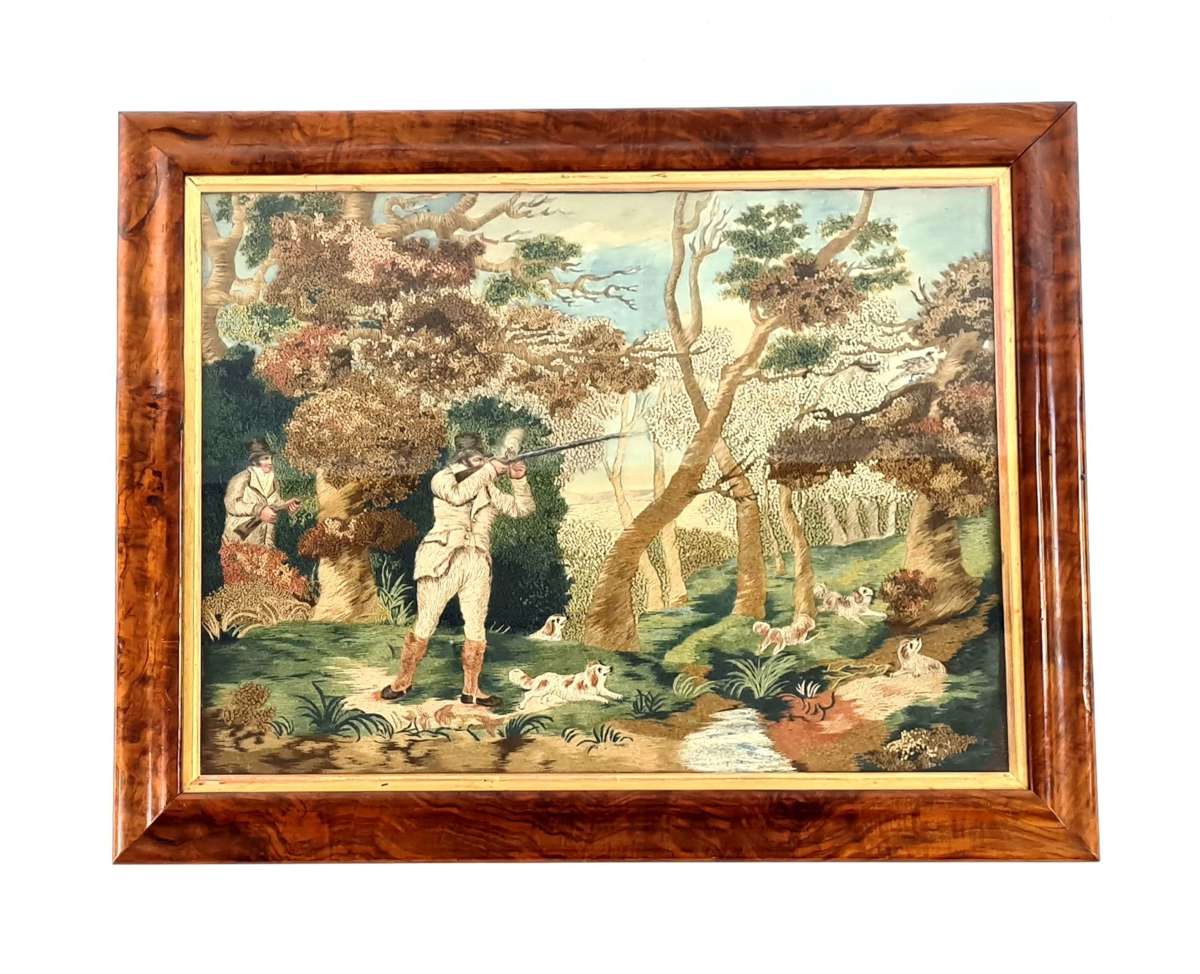
If you buy something framed decades ago, it is worth having a look inside. Pieces nailed to bare wood or pasted to brown card are common, and both cause the staining you often see creeping in from the edges. Many of the framed antique embroidered panels and wall hangings listed by our dealers include silkwork, crewelwork and needlework pictures where the mount matters as much as the stitching. Arts and Crafts era embroidery is a rich seam here, and our Arts and Crafts style guide gives the wider context.
Storing what you are not showing
Roll rather than fold wherever you can, because permanent creases eventually become splits. Use a tube padded with acid free tissue, roll with the design facing outwards, and interleave with more tissue.
Where folding cannot be avoided, pad the folds with tissue and refold along different lines every year or so. Store in cotton bags or acid free boxes rather than plastic, which traps moisture and encourages mould. Choose a cupboard inside the house rather than a loft or a garage, since textiles suffer far more from swings in temperature and damp than from anything else.
Cushions and fragments
A great many antique cushions are made from fragments of older textiles, using the good surviving section of a worn tapestry, needlework panel or piece of embroidered silk. There is nothing wrong with this, and it is a sensible use of something otherwise unusable, but do ask what is original and what is new. A cushion made from an 18th century panel and a cushion made from 1970s furnishing fabric can look surprisingly similar in a photograph.
Cushions are also the gentlest way to start. They cost less, they need no hanging system, and they teach your eye to read stitches and dyes.
Where to begin
Buy the piece with the most honest condition report rather than the prettiest photograph. Read what the dealer says about fading, moth and repairs, and ask for pictures of the reverse if none are shown.
Then keep it out of the sun, look at it often, and clean it as little as you possibly can. Have a browse through the textiles our dealers are listing and see which ones hold your attention. The named sampler with a slightly faded verse will probably outlast anything else you buy this year.


