


How to Identify and Date Antique Mirrors
|
Tuesday 4th August 2026 at 08:21 By Olivia |
 |
Mirrors are easy to overlook. They hang quietly on the wall and get on with their job, and most of us never stop to wonder how old the one in front of us might be. Yet a mirror can carry as much history as any chest of drawers or longcase clock, and once you know what to look for, a surprising amount of that history is written into the glass and the frame.
The reassuring part is that you do not need specialist equipment to make a sensible judgement. A good light, a careful eye and a little patience will take you a long way. Here is how to read the clues.
Start with the glass
The most useful place to begin is the mirror plate itself. The way glass was made and silvered changed enormously over the centuries, and those changes leave marks you can learn to recognise.
Until roughly the 1830s, mirrors were silvered using an amalgam of tin and mercury. The result is a soft, faintly grey reflection with a gentle sparkle, quite unlike the bright, even finish of a modern mirror. From the middle of the nineteenth century a new method using silver nitrate took over, giving a brighter and more uniform surface. So a mirror with a softer, greyer, slightly uneven reflection may well predate the 1840s.
A word of caution. Old mercury backing is toxic and can flake, so never scrape or disturb the rear of an early plate. Look, but do not touch. If marks and makers interest you, our guide to antique silver hallmarks explores a related kind of detective work.
Modern glass gives itself away too. Float glass, the standard since the late 1950s, is perfectly flat and colourless. Older plates are usually thinner, often carry a faint grey or green tint, and may show slight ripples or tiny bubbles when you tilt them against the light.
Foxing and honest wear
Over time the silvering on an old plate breaks down. You will see cloudy patches, dark spots and areas where the reflection has faded altogether, usually worse towards the edges and corners where moisture creeps in. Dealers call this foxing, or desilvering, and on a genuine old mirror it tends to be uneven and organic, as if it grew there slowly.
Be a little wary of speckling that looks too pretty or too evenly spread. Glass can be distressed artificially to imitate age, and uniform, decorative spotting across the whole plate is sometimes a sign that the ageing was helped along.
How the plate was made and joined
Before the nineteenth century, glass could only be made in fairly small sheets. To create a tall mirror, makers joined two or more plates together, and you can often spot the faint horizontal line where they meet. A large early mirror built from several plates is a strong sign of real age.
Bevelled edges are worth examining as well. Early bevels were cut and polished by hand, so they are shallow, soft and very slightly irregular. A crisp, wide and perfectly even bevel usually points to later work done by machine.
Reading the frame
Turn the mirror over whenever you can, because the back often tells you more than the front. Look for old timber, genuine oxidation, joints cut by hand and the kind of dust and wear that takes decades to build up. Old nails differ from modern wire nails, and an original backboard in oak or pine is a reassuring touch.
The decoration matters too. Many gilded frames were built up in carved wood, gesso and a moulded composition known as compo, which became popular from the late eighteenth century. Genuine gilding wears in a believable way, with the high points rubbed back to the red clay or pale gesso beneath. Look for fine shrinkage cracks in the gesso, which are difficult to fake convincingly.
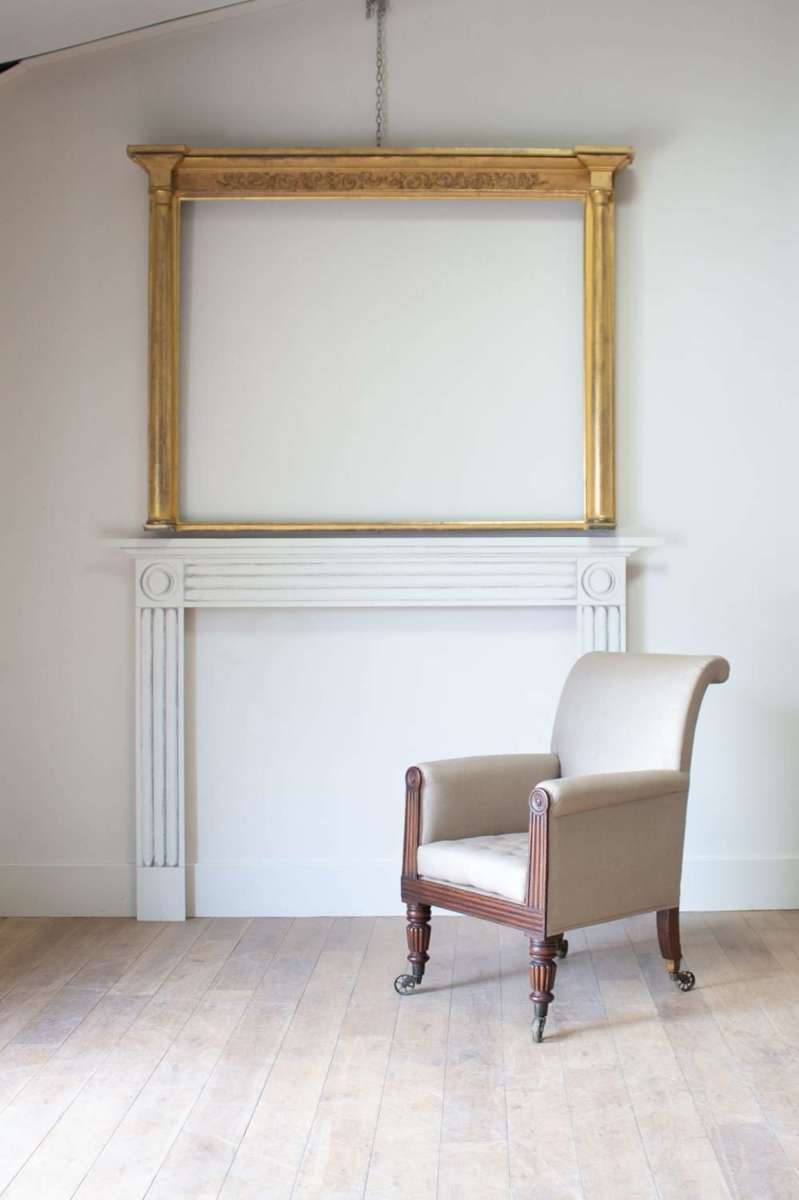
Gilded frames are one of the real pleasures of the field, and you can see the range across our collection of antique gilt mirrors.
Dating by style and period
Style is one of the friendliest ways to place a mirror in time, and it pairs nicely with what you may already know about furniture. Our guide to the most popular styles of antique furniture is a useful companion, because mirrors tended to follow the same fashions.
Georgian makers loved carved giltwood, with the playful scrolls and foliage of the rococo giving way to the calmer urns and ovals of neoclassical taste later in the century. The Regency period brought the circular convex mirror, often topped with an eagle or a row of small gilt balls and sometimes called a butler's mirror, because the bowed glass let a servant take in the whole room at a glance.
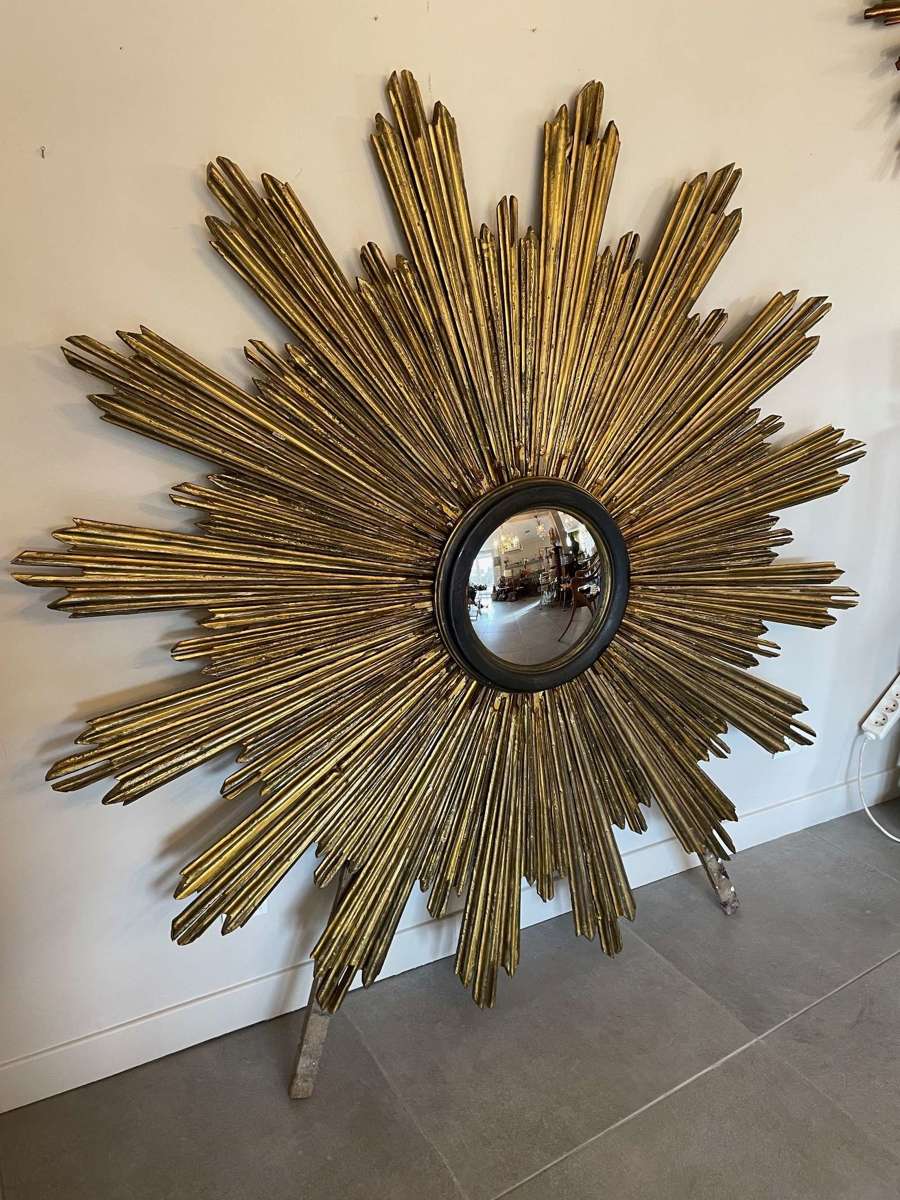
That distinctive bowed glass is unmistakable once you have seen it, as our antique convex mirrors show.
The Victorians, helped by cheaper large plates, went in for grand overmantel and pier mirrors with heavier gilt and gesso. French taste runs from the giltwood of Louis XV and Louis XVI to the painted trumeau, where a decorative panel sits above the glass.

You can see that elegance for yourself in our antique French mirrors.
Venetian mirrors, with their engraved and bevelled glass borders, are a style all of their own, admired since the glassmakers of Murano perfected their craft. The oldest examples often show that lovely soft foxing in the border plates.

Browse a few and the difference soon becomes clear in our antique Venetian mirrors.
The early and middle twentieth century added its own favourites, from Arts and Crafts oak and hammered copper frames to the bold sunburst mirrors that still feel fresh today.
Beware the marriage
One last thing to keep in mind. Mirrors are often altered. An old frame may hold a modern replacement plate, an old plate may have been given a fresh silver backing, and sometimes a genuine antique frame is paired with later glass entirely. This is known as a marriage. It is not always a problem, but it should be reflected in the price. When the wear on the frame and the ageing of the glass tell different stories, it is worth asking a few questions.
Trust your eye, and ask
Identifying and dating a mirror is really a matter of gathering small clues until they agree with one another. The glass, the silvering, the bevel, the frame and the style should all point to roughly the same moment in time. When they do, you can buy with confidence.
If you would like to put your eye to the test, take your time over our full range of antique mirrors and see how many of these details you can spot for yourself. And if you are just getting started, our guide to starting an antique collection is a gentle place to begin.


